Scaling Global Corporate Training with Custom LMS and AI Content Tools

Published


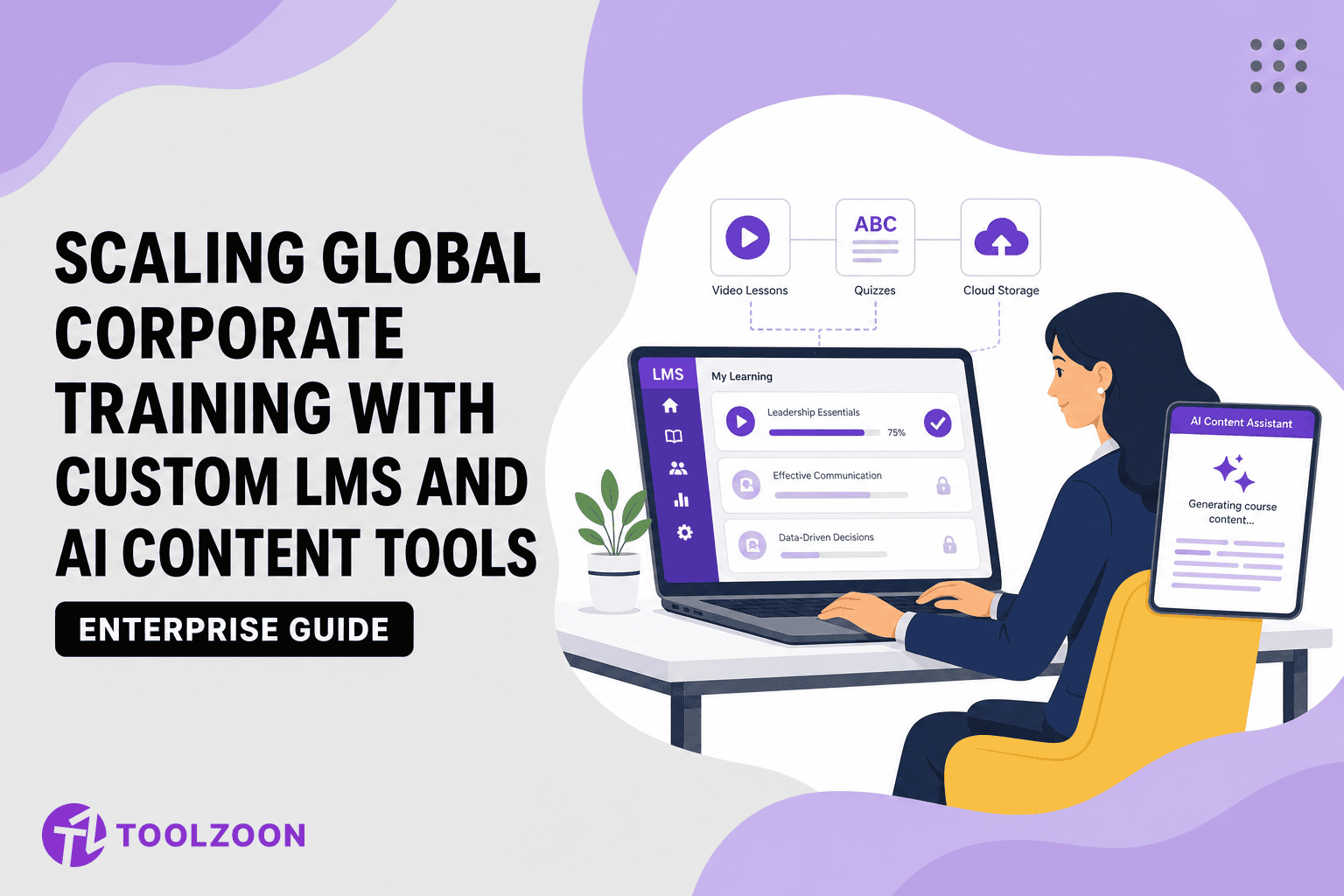
Large enterprises face a critical bottleneck in employee development. Traditional training methods fail to keep pace with rapid industry shifts and global expansion. Decision-makers often choose between rigid off-the-shelf software and expensive manual content creation. Neither option offers the scalability required for modern business.
High-performance education needs a dual approach. It needs a robust, custom-built infrastructure and an efficient content production workflow powered by intelligent tools. When the platform and the writing process work together, training teams can ship new modules faster without giving up data control or quality.
The Architectural Foundation for Scalable Learning
The Limitations of Generic LMS Platforms
Generic Learning Management Systems often impose limits on data ownership and feature customization. These constraints become visible when an organization tries to integrate proprietary workflows or unique security protocols. A bespoke architecture solves these issues by aligning technical capabilities with business goals.
High-end development ensures that the platform supports spikes in usage and handles heavy video traffic without downtime. This level of reliability is non-negotiable for firms operating across multiple time zones.
The Value of Bespoke Development
Modernizing legacy training systems requires more than a simple interface update. It demands a complete rethink of how data flows between administrators and learners. Specialized providers like Binary Studio focus on creating these high-performance web and mobile platforms that automate administrative tasks and facilitate progress tracking.
Their approach leverages over two decades of EdTech experience to build systems that support structured programs and complex institutional workflows. By utilizing a dedicated engineering team, businesses can implement advanced features such as automated reporting, voice assistance, and secure cloud storage that off-the-shelf products often lack. This specialized development allows for a scalable foundation where the learning flow meets the specific permissions and roles required by the organization.
The benefits of a custom approach extend to user engagement. Tailored UX design keeps employees moving forward through their curriculum. When a platform feels intuitive, retention rates naturally improve. Custom testing and quality assurance also ensure that critical flows, such as payment gateways or certification modules, remain stable from day one. This proactive technical strategy prevents the accumulation of technical debt that frequently plagues standardized solutions.
Accelerating Content Cycles with AI Workflows
Streamlining Instructional Content Creation
Once the infrastructure is stable, the next challenge is content. A custom LMS is only as effective as the material it hosts. Building a library of videos, quizzes, and text modules for thousands of employees is a monumental task. This is where AI-powered writing tools become a force multiplier for instructional designers.
These tools allow creators to move from initial ideas to finished drafts in seconds. They effectively eliminate the friction associated with writer's block in corporate settings. Productivity increases when teams integrate modular AI helpers into their daily routines.
For Example:
A paragraph generator can quickly expand on core technical concepts to create comprehensive study guides. A summarization tool takes long internal documents and condenses them into microlearning snippets that busy professionals can actually finish.
These tools are designed to be lightweight and instant, requiring no complex setups or accounts to start producing results.
Turn long policy docs into short learning snippets.
Scaling SEO and Educational Content
Technical teams and marketing departments within EdTech firms also benefit from these efficiencies. Generating SEO-optimized meta descriptions and FAQs for educational landing pages ensures that internal resources are discoverable. When an organization can produce high-quality text at scale, it reduces the need for large, expensive copywriting teams.
This cost-saving measure allows the budget to be reallocated toward further technical improvements or advanced curriculum design.
Pro Tip:
Use Toolzoon's free meta description generator and AI FAQ generator to make training pages easier to find. Enter the module title and key points to get instant, search-ready copy.
Bespoke educational ecosystems provide several measurable advantages for the enterprise:
- Complete control over data privacy and HIPAA or GDPR compliance requirements.
- The ability to integrate seamlessly with existing CRM and ERP systems.
- Reduced long-term costs by eliminating per-user subscription fees.
- Faster deployment of new training modules through AI-assisted drafting.
- Enhanced mobile-first experiences for learning on the go.
The integration of these technologies follows a logical progression. Success depends on a clear understanding of the project scope and the desired outcomes for the workforce.
- Analyze specific training requirements and identify gaps in the current software stack.
- Partner with a development team to build or modernize the core LMS architecture.
- Implement cloud-based infrastructure to handle video content and high traffic.
- Standardize AI-driven workflows for creating and updating course materials.
- Establish a cycle of continuous testing and feedback to refine the user experience.
Draft SEO-ready course pages and study guides faster.
Strategic Outcomes and Long-term Value
Building Sustainable Learning Ecosystems
The combination of custom engineering and AI productivity creates a sustainable learning environment. It shifts the focus from managing software limitations to achieving educational excellence. Enterprises that own their platform are not at the mercy of a third-party vendor's roadmap. They can pivot their training strategies as quickly as the market demands. This agility is a significant competitive advantage in industries where knowledge is the primary asset.
Leveraging Analytics for Precise Curriculum Updates
Modern platforms also offer superior analytics. Custom reporting tools allow leaders to see exactly where learners struggle. This data-driven insight enables precise updates to the curriculum. When combined with AI tools that can rewrite difficult sections in seconds, the improvement cycle becomes incredibly fast.
For Example:
If completion drops on a dense compliance module, use the outline generator to break the lesson into shorter modules, then rewrite the weak sections with the AI blog writer. The result is a workforce that stays up to date with less friction and lower operational overhead.
Investing in high-quality development and intelligent content tools is a strategic necessity. It ensures that the organization can scale its most valuable resource: its people. By focusing on a scalable foundation and efficient production, firms protect their future growth. The shift toward integrated, high-performance learning ecosystems is no longer a luxury but a requirement for global success.
Conclusion
Effective corporate education requires a balance of stability and speed. Custom architecture provides the stability, while AI tools provide the speed. Together, they form a modern solution for the complex challenges of enterprise training. This approach minimizes risks and maximizes the return on every hour spent in professional development.
Organizations that adopt this model will find themselves better positioned to handle the challenges of a digital-first economy. They will lead their industries through superior talent management and technological foresight.
Build training content with Toolzoon AI writing tools
FAQs
1. Why do generic LMS platforms struggle at enterprise scale?
They often limit data ownership, custom workflows, and security rules. A custom LMS can match your roles, integrations, and traffic needs across time zones.
2. How do AI writing tools speed up corporate training content?
Yes. Instructional designers can draft study guides, summaries, FAQs, and module copy in minutes, then spend more time on accuracy and learner experience.
3. What advantages does a custom LMS offer over subscription software?
You keep control of privacy and compliance, integrate with CRM or ERP systems, avoid per-user fees over time, and ship new training modules on your own timeline.
4. Can AI tools help with SEO for educational pages?
Yes. Tools like a meta description generator and FAQ generator help training and EdTech teams publish discoverable landing pages without a large copywriting staff.
5. What is the best first step toward a scalable training ecosystem?
Start by mapping training gaps and current software limits. Then modernize the LMS foundation, add cloud capacity for video, and standardize AI drafting for course updates.