AI Chatbots for Writing Prompts: Which One Should You Use?

Published


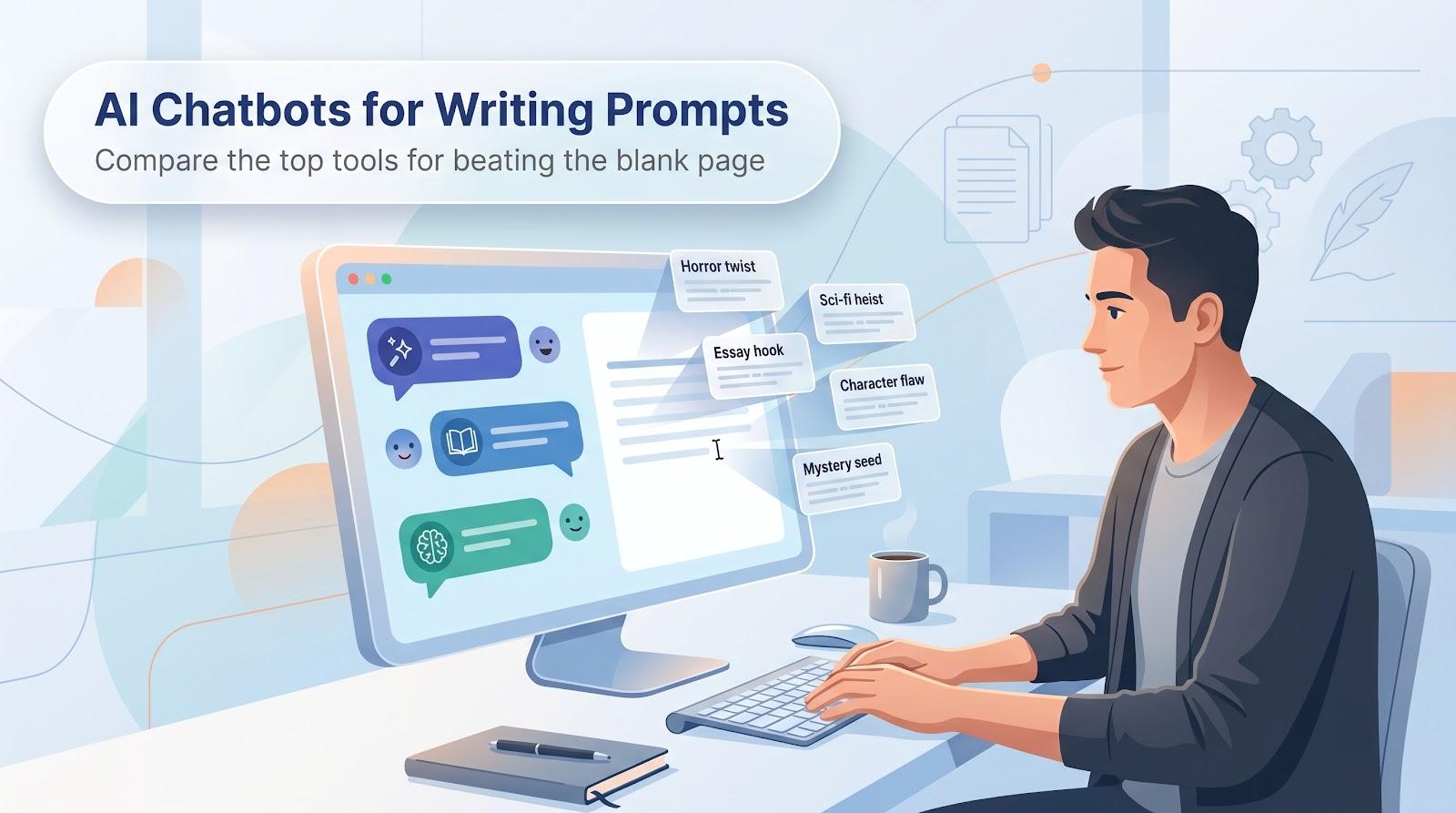
Staring at a blinking cursor is rough, and coffee only carries you so far. The right AI prompt generator sparks ideas, reframes half-formed thoughts, and keeps a session flowing.
Since 2024, hundreds of "prompt engines" have crowded the field. During May 2026 we put eight of them through nine weighted tests, then narrowed the list to the top three.
Here is what you will find:
- Why prompt tech exploded - and where it still falls short
- Our scoring rubric for transparency
- Candid reviews of the three winners
- A quick-scan table and decision path to fit any workflow
Ready to meet your new writing partner? Read on.
The Big Bang: Why Prompt Generators Are Everywhere
Two years ago "prompt engineering" sounded like obscure jargon. Now every writing Slack has at least one link to "the ultimate prompt builder." What changed?
First, demand surged. When ChatGPT opened access, millions realized they could hand the blank-page moment to a bot. Copycats followed, each promising faster, quirkier, or safer ideas. Venture funding poured in, pushing the tool count from a handful in 2023 to hundreds today.
Second, the tech grew up. Context windows - the text a model remembers - stretched from postcard size to novel length. Anthropic's Claude 4.6 now offers a one-million-token window on Max, Team, and Enterprise plans. An AI can absorb an entire draft and then propose prompts that mesh with chapter twenty-three's cliff-hanger. Writers noticed.
Third, policies diverged. Corporate models tightened safety filters while indie platforms like DreamGen leaned into creative freedom. Two camps emerged: users who want a family-friendly brainstorming partner and users who prefer an uncensored collaborator.
Together, these forces created a crowded market that rewards nuance over volume. The next sections separate signal from noise and reveal where current tools still frustrate real writers.
How We Scored Every Bot
Comparisons mean little if the yardstick keeps moving, so we finalized a rubric before the first test.
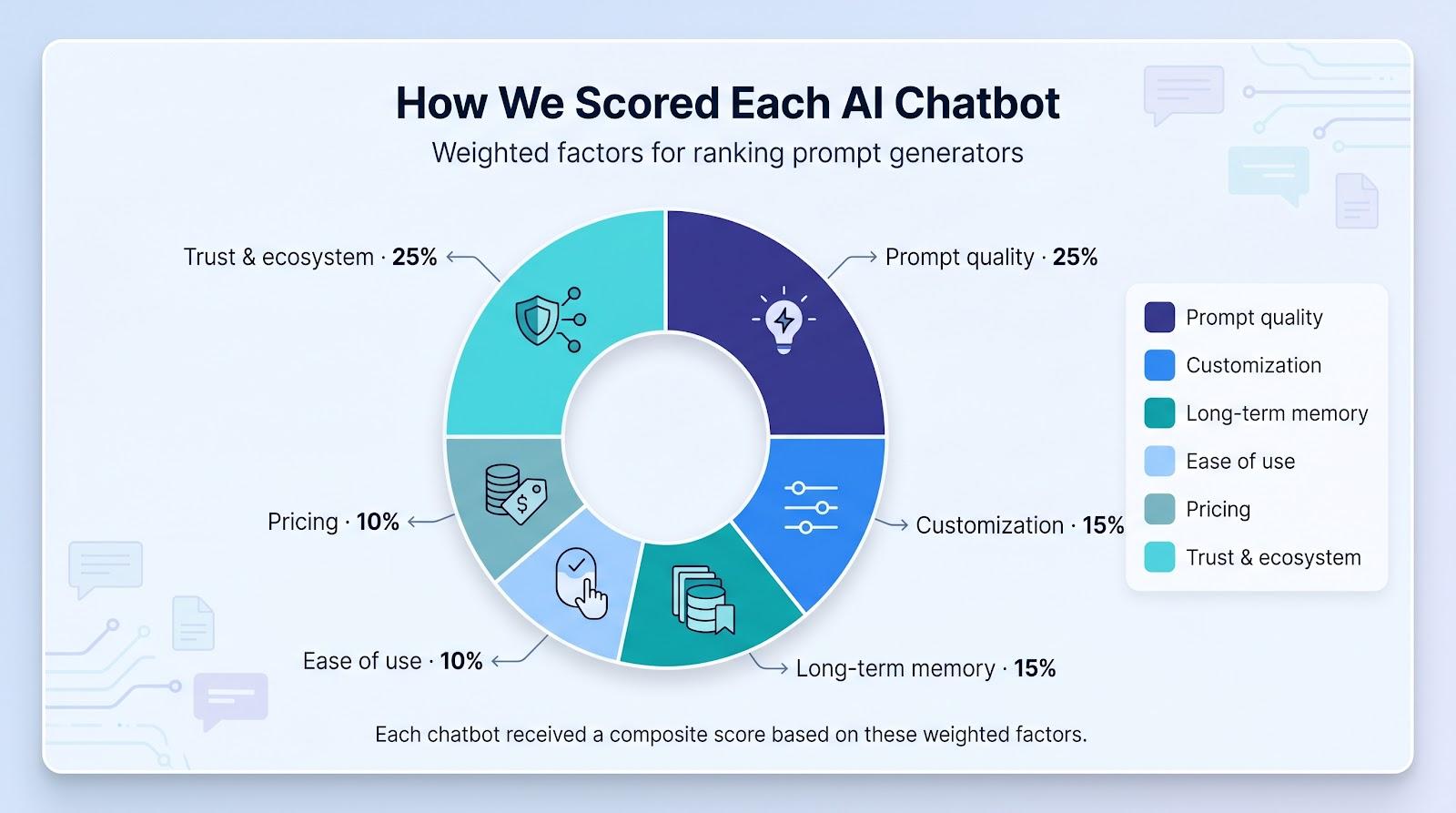
We weighted five core factors - originality, control, memory, speed, and cost - and converted the results into one composite score.
- Prompt quality carried 25 percent.
- Customisation and long-term memory followed at 15 percent each, because an idea loses value if you cannot guide the tone or if the bot forgets earlier chapters.
- Ease of use and pricing held 10 percent each; writers do not have time for hidden menus or surprise fees.
- The final 25 percent covered transparency, integrations, privacy, and community support.
Every review followed a four-part pattern: context, definition, expansion, suggestion. After running dozens of live sessions, we measured response times, logged refusals, and tracked genuine sparks of creativity. Those data points set the final ranking.
From Longlist to Shortlist
Our first pass was generous. We invited eight AI tools to the party: household names, niche favorites, and a few "why not test it?" picks. Then we applied strict filters.
Any product that was not a true back-and-forth chatbot left the table. Sudowrite writes stylish prose, but its menu-driven interface cannot riff with you line by line. NovelAI and Character.AI fell for the same reason: great for story continuation, less helpful when you need rapid-fire prompt ideas.
Next came creative depth. Google's Gemini aced factual Q&A, yet in our tests its fiction prompts stayed surface level. Bard earned an honorable mention, nothing more.
We also weighed friction. If you must watch a thirty-minute tutorial before the first prompt, most writers will bounce.
After the culling, three contenders kept meeting our benchmark: DreamGen, ChatGPT (GPT-4), and Anthropic's Claude 4.6. Each supports live chat, produces reliably original ideas, and serves a distinct creative niche.
DreamGen: #1 for Flexible Story Prompts
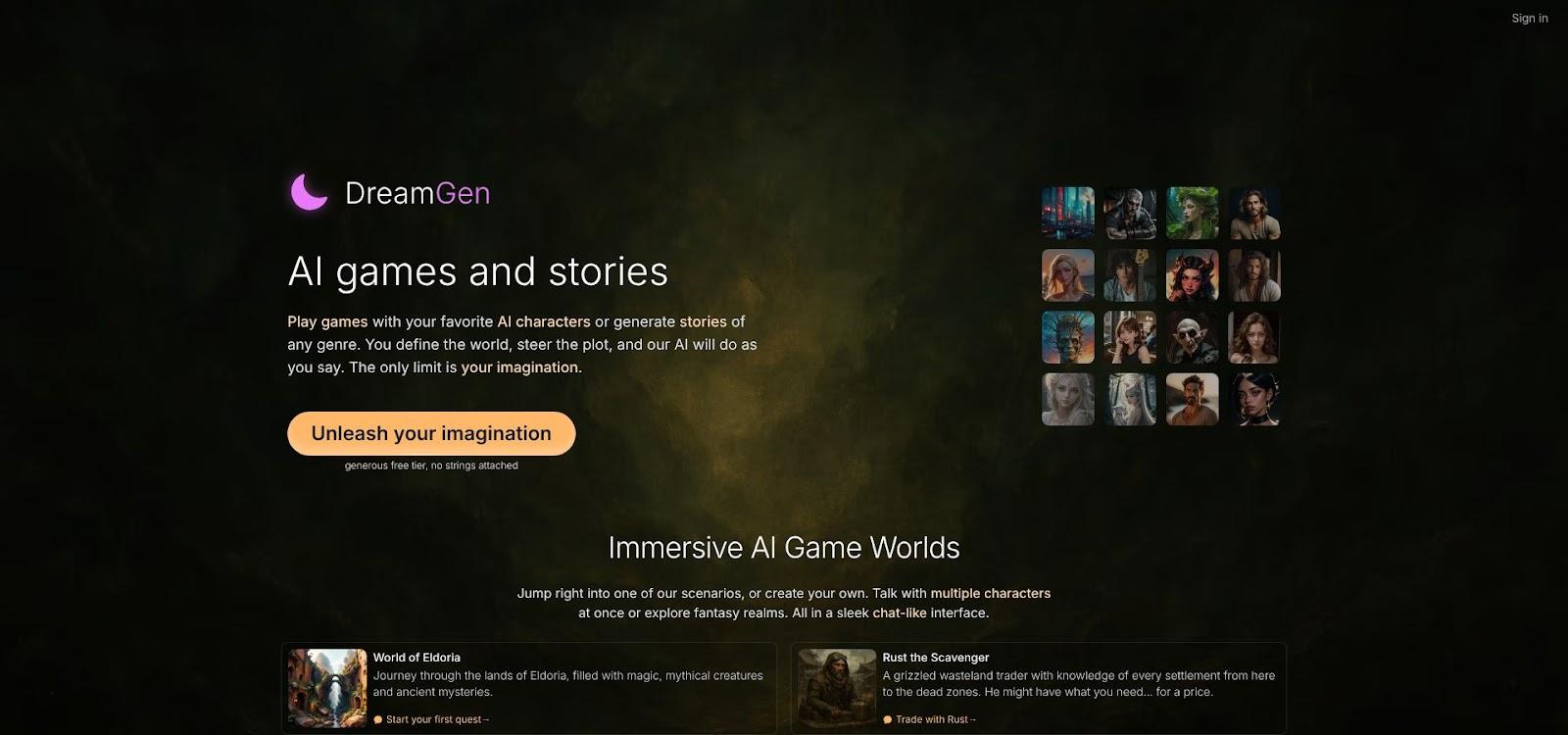
DreamGen fiction prompt generator interface screenshot
Why It Ranks First
DreamGen focuses on one job and does it well: generating fiction prompts that stay in character, honor your lore, and keep writing sessions moving without policy roadblocks.
Where general chatbots juggle code, recipes, and emails, DreamGen funnels its training budget into narrative craft. Its first-party models - GLM 4.7 and Lucid Max (based on Llama 3 70B) - are fine-tuned on dialogue, so the prose feels cinematic rather than corporate.
Writers also gain specialized tools. The Scenario Codex acts like a private wiki; load your world history, character sheets, or earlier chapters, and every new prompt reflects that context. When inspiration runs thin, DreamGen's built-in prompt search digs through more than 5,000 top-scoring Reddit prompts and serves them inside the chat.
DreamGen leans into creative freedom. Ask for a gothic romance with moral ambiguity and the system complies instead of apologizing. More than one million registered users and over 5,000 Discord members confirm that policy flexibility is a draw.
Stack these advantages against our rubric and DreamGen scores near perfect in prompt quality, customisation, and content freedom. If your writing relies on deep lore and uncensored ideas, this is the place to start.
ChatGPT (GPT-4): #2 for Versatile Prompts
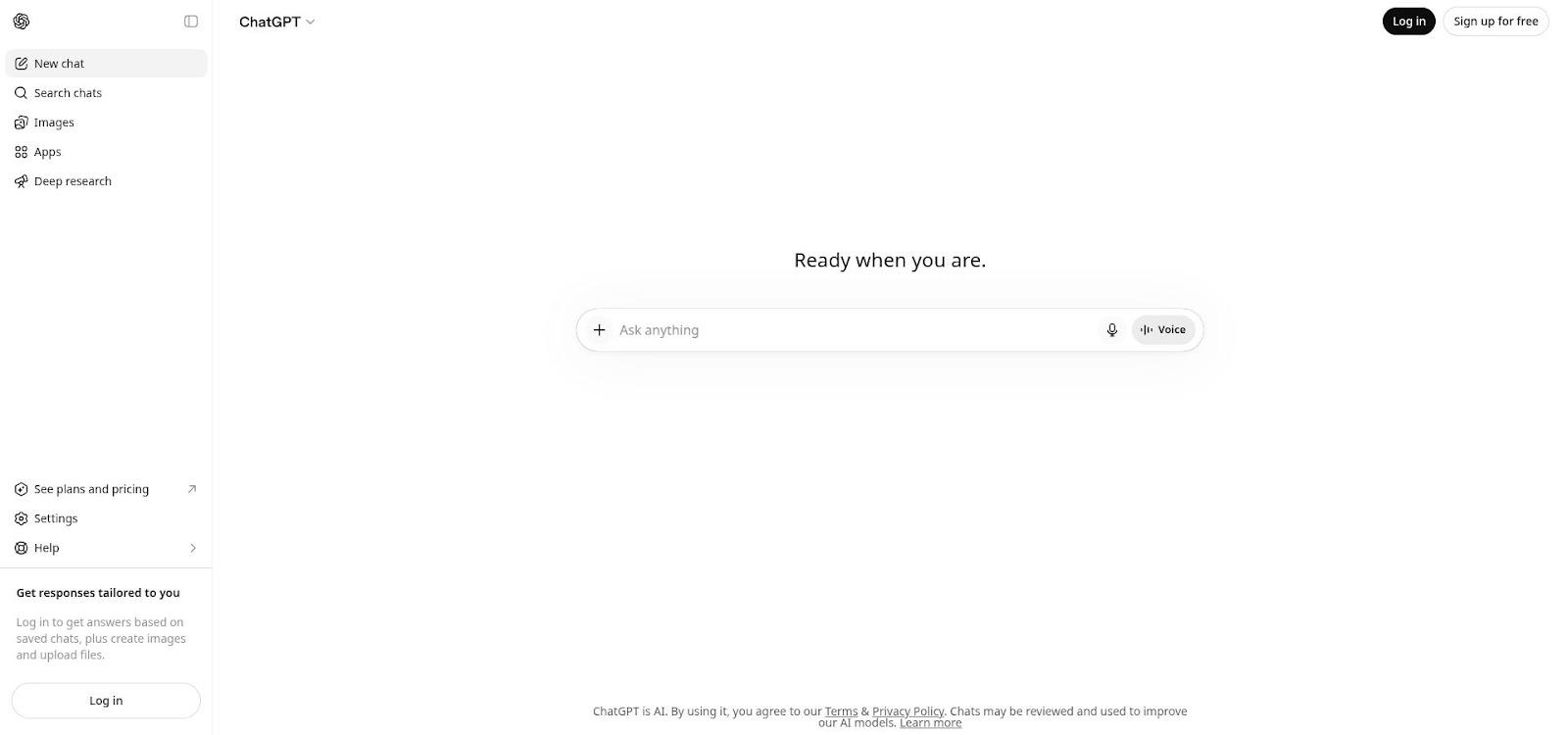
ChatGPT GPT-4 writing prompt chat interface screenshot
Where It Shines
ChatGPT feels like a downtown library - open late, full of references, and staffed by a helpful guide. Type a request and it responds in seconds with fresh prompts, a Shakespearean sonnet, or a rewrite in cyberpunk slang. That friction-free start is one reason it anchors the world's largest prompt-sharing community.
GPT-4 also offers breadth. Need prompts grounded in recent medical research? It cites real studies. Want a bilingual journal-entry starter in Spanish and English? Done. The model's training set plus optional web tools keep facts close at hand, a perk niche engines cannot match.
Where It Trails
Safety filters please compliance teams but limit darker genres. Ask for explicit horror or steamy romance and you often meet a polite refusal or a fade-to-black summary. That is fine for PG-13 work; writers exploring mature themes may feel boxed in.
Memory is another trade-off. Standard GPT-4 stores about 8,000 tokens - enough for a short outline but not a full novel's lore. Manual summaries slow momentum compared with Claude's one-million-token capacity or DreamGen's Codex.
Verdict
ChatGPT lands in second place because it makes high-quality prompt generation simple for nearly every genre short of the truly edgy. Its speed, knowledge, and vast community solve problems in minutes that once took hours of searching. If you value convenience over uncensored depth - and you are happy to spend twenty dollars a month for GPT-4 - ChatGPT remains the default creative sidekick for most writers.
Claude 4.6: #3 for Marathon Brainstorms
Claude 4.6 long-context writing assistant interface screenshot
What Makes It Special
Claude's strength is memory. A single chat can hold an entire novella - up to one million tokens for Max, Team, and Enterprise users. Drop your draft, research pile, and notes into one thread and Claude keeps every detail straight, so you never repeat yourself.
This depth pairs with a warm writing style. Claude often responds like a thoughtful editor, unpacking themes and suggesting prompts that hint at emotional stakes. Many writers prefer this measured tone to ChatGPT's brisk replies.
The Trade-offs
All that context costs time. Ask for one prompt and Claude may send three plus commentary. You can curb the extra copy by starting with "twenty words max," but it requires active trimming.
Access can also be uneven. Official web sign-ups still roll out by region, so some users rely on third-party portals that limit daily messages. Rate caps appear sooner than with ChatGPT, especially after pasting large documents.
Content filters sit between ChatGPT's strict wall and DreamGen's open door. Claude usually allows moderate mature themes yet stops at explicit detail, so horror and romance writers might see occasional refusals.
Verdict
Claude ranks third because it solves one pain no other mainstream model tackles: staying coherent across book-length context. If your workflow involves massive reference material, Claude is the tireless assistant that remembers every bullet. Just be ready to trim its lengthy answers and plan around regional availability.
Feature Showdown: How the Big Three Stack Up
Numbers help, but a shared grid lets you spot trade-offs at a glance.
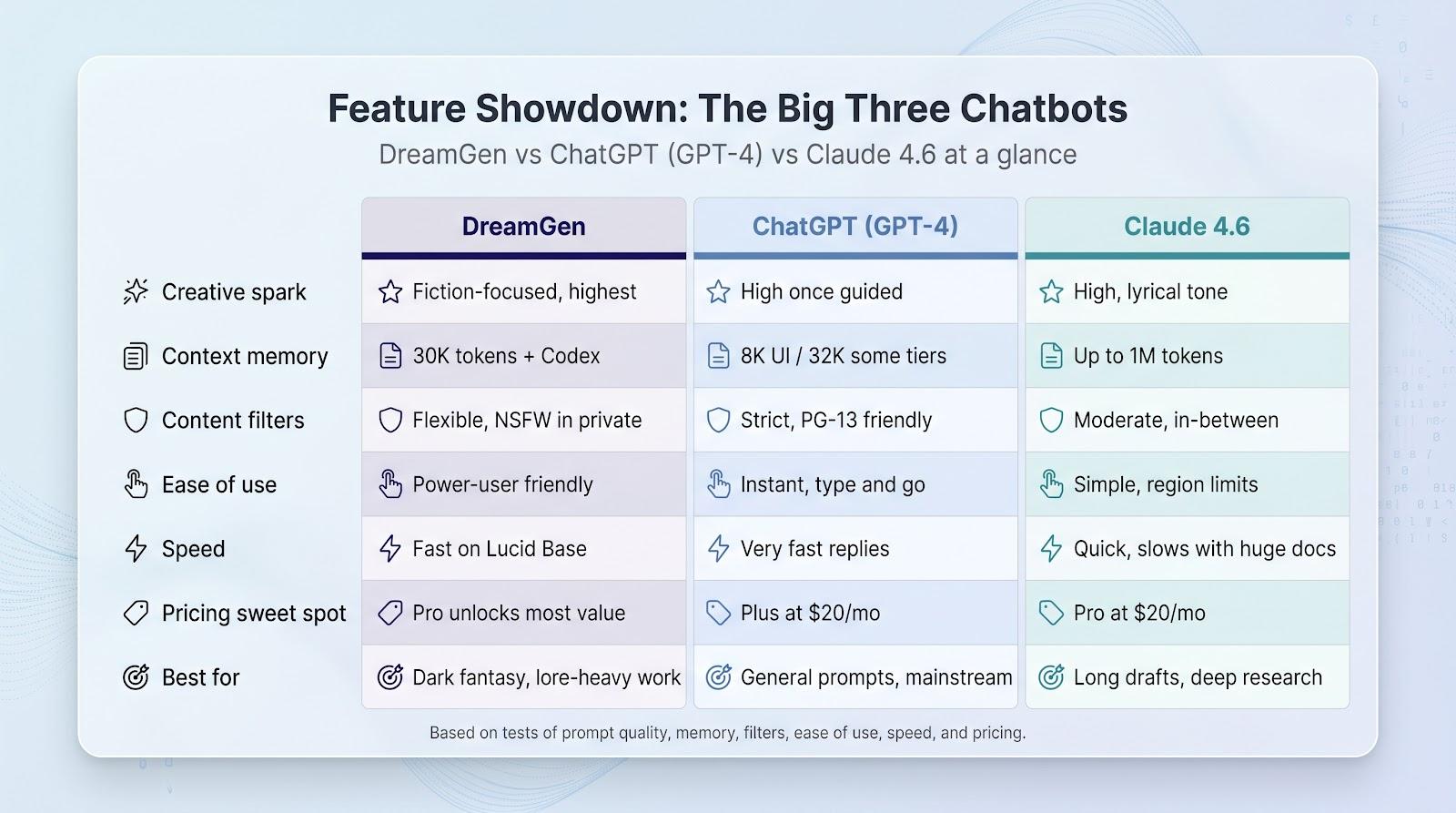
| Capability | DreamGen | ChatGPT (GPT-4) | Claude 4.6 |
|---|---|---|---|
| Creative spark | Fiction-focused, highest | High once guided | High, lyrical tone |
| Context memory | 30K tokens + Codex | 8K UI / 32K some tiers | Up to 1M tokens |
| Content filters | Flexible, NSFW in private | Strict, PG-13 friendly | Moderate, in-between |
| Ease of use | Power-user friendly | Instant, type and go | Simple, region limits |
| Speed | Fast on Lucid Base | Very fast replies | Quick, slows with huge docs |
| Pricing sweet spot | Pro unlocks most value | Plus at $20/mo | Pro at $20/mo |
| Best for | Dark fantasy, lore-heavy work | General prompts, mainstream | Long drafts, deep research |
Pick Your Partner: A Quick Decision Path
Choosing a prompt generator can feel overwhelming. Focus on one question at a time.
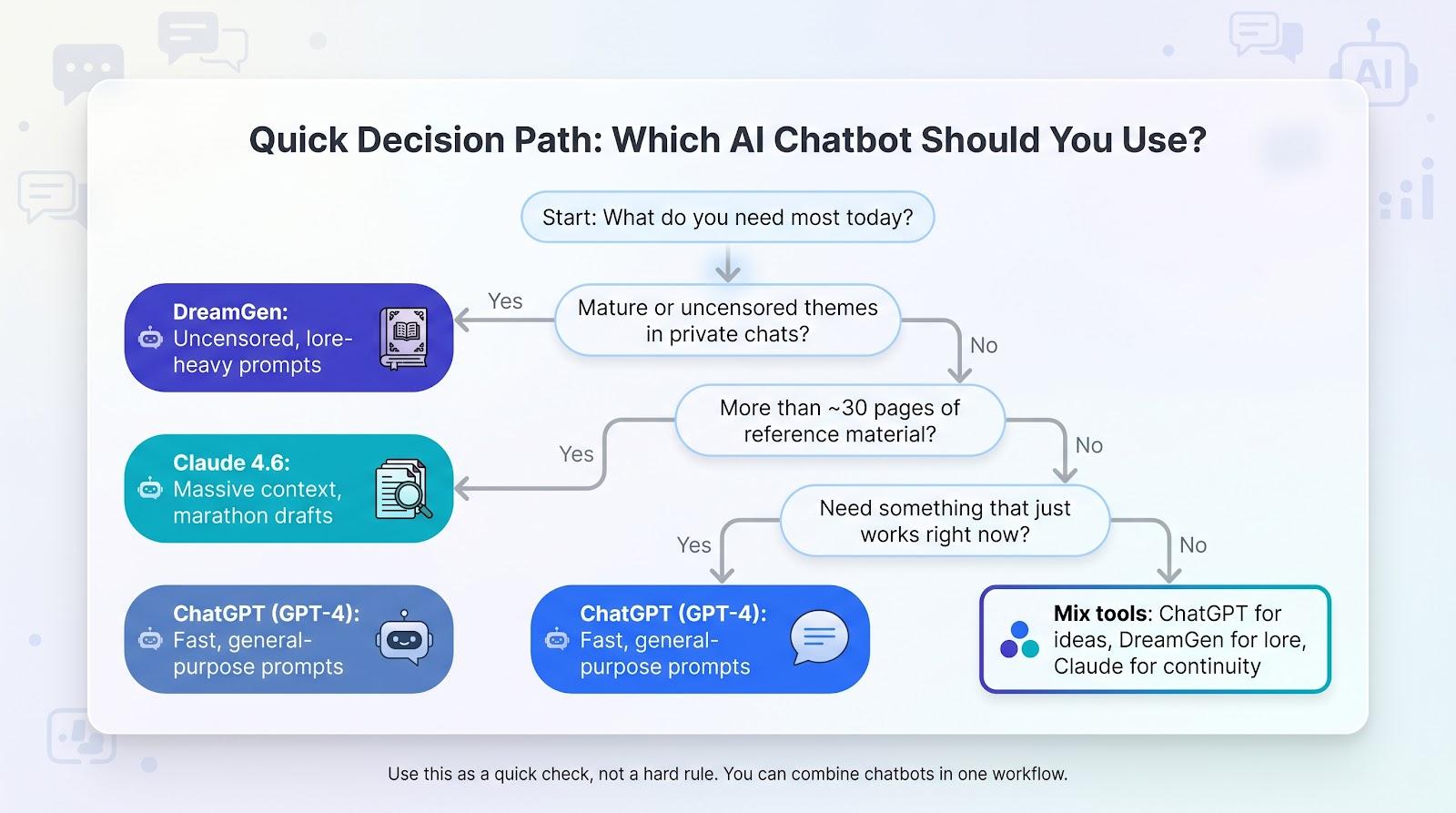
-
Do you need complete creative freedom, including mature themes in private chats?
- Yes → Choose DreamGen and set up a Scenario Codex.
- No → Go to question two.
-
Will the session include more than thirty pages of reference material?
- Yes → Claude 4.6 is built for deep memory.
- No → Move to question three.
-
Is setup time or a learning curve a deal-breaker today?
- Yes → Open ChatGPT and start typing.
- No → Revisit DreamGen or Claude based on budget and theme.
Treat this path as a quick check, not a rule. You can mix tools: brainstorm twists in ChatGPT, add lore with DreamGen, then run continuity checks in Claude. Let each model solve the task it handles best instead of forcing one AI to cover every need.
What It Costs to Play
Even the best prompts lose appeal if every click feels like a meter running. Here is the pricing landscape so you can budget brain-power, not just dollars.
| Plan | Free tier | Mid-range sweet spot | Power-user max |
|---|---|---|---|
| DreamGen | ~2,000 RP messages/month on Lucid Base, 250/day after credits, plus 150 images. | Pro unlocks unlimited first-party models and a 60% discount on third-party models. | Context windows up to 30,000 tokens on GLM 4.7 for marathon sessions. |
| ChatGPT | Unlimited chats on GPT-3.5. Good for light prompts. | Plus - $20/mo unlocks GPT-4, browser tools, and priority uptime. | Enterprise seats add compliance controls and higher limits; pricing scales by user count. |
| Claude 4.6 | Free web beta in supported regions or via Poe, with daily caps. | Pro - $20/mo lifts caps and grants the latest high-quality model with up to 1M tokens. | API billing by token may exceed a flat plan for very large projects. |
- ChatGPT's free tier still delivers value for light use.
- DreamGen's Pro plan offers the broadest upgrade for fiction writers.
- Heavy long-context work may push Claude's API billing higher than a subscription.
Always check each platform's release notes before you commit; quotas and token prices can shift with little notice.
Mind the Gaps: Risks and Real-World Friction
AI prompt tools move fast. A month after testing, Claude announced another context upgrade; two weeks later DreamGen tweaked its free-tier quotas. Before you publish or pay, skim each platform's release notes and pricing page again.
Privacy is another watch-out. ChatGPT lets you turn chat history off, yet your words still pass through OpenAI's servers. DreamGen runs its own models and stores data separately, but policies can change without broad press coverage. If you feed any tool confidential drafts, get written clarity on retention and training rules.
Regional access also varies. Claude's web interface still limits sign-ups in some countries, so writers elsewhere rely on third-party portals that change quota rules overnight. VPN workarounds break terms of service and risk account loss. Keep a backup plan if an international team needs stable access.
Finally, remember that large language models hallucinate. Creative prompts thrive on imagination, yet any "fact" they insert may be wrong. When accuracy matters, cross-check with a primary source before hitting send.
Two-Minute Cheat Sheet
Need a quick refresher before your next writing sprint? Copy this list, pin it to your desktop, and you are set.
- DreamGen - Best for deep-lore fiction and uncensored scenes. Large Codex memory plus flexible filters.
- ChatGPT (GPT-4) - Fast, versatile, fact-aware. Ideal for general brainstorming and cross-genre work.
- Claude 4.6 - Remembers entire books. Choose it when you need continuity across long drafts.
Fast rules of thumb:
- Mature themes? → DreamGen.
- Short deadline? → ChatGPT.
- Research files in the thousands of words? → Claude.
Conclusion
The surge of AI prompt generators means writers no longer have to face the blank page alone. DreamGen, ChatGPT, and Claude 4.6 each excel in different scenarios - whether it is uncensored creativity, all-purpose versatility, or marathon-length context. Match your needs to their strengths and you will keep every writing session moving forward.